Category: Visas

  • U Visa and T Visa: Requirements, Certifications, Differences 

    Congress passed the Victims of Trafficking and Violence Protection Act (VTVPA) in 2000. This law created two nonimmigrant visas for victims of certain crimes and trafficking: the U visa and the T visa. 

    The U visa is for victims of certain crimes, while the T visa is for victims of human trafficking. These visas allow victims to remain in the United States. Also, they help in investigating or prosecuting the crimes committed against them.

    This law grants temporary status to some individuals in the United States. These people have been victims of severe trafficking or have suffered significant physical or mental abuse due to criminal activity. 

    The legislation aimed to address the trafficking of individuals. These individuals are victims of sexual exploitation, slavery, and forced labor. It also aimed to renew federal programs to prevent violence against immigrant women and children. It offers similar immigrant benefits to those available to refugees, with the added possibility of obtaining permanent resident status.

    Congress established the T and U visas to encourage victims of certain serious crimes, including human trafficking. The law encourages them to work with law enforcement to prosecute criminal offenders. These visas are available to victims of specific crimes. Both the T and U visas encompass human trafficking as a qualifying crime.

    U Visas for Victims of Crime

    The U visa is a nonimmigrant visa available to individuals who have been victims of certain criminal activities. They may have information about such activities. Individuals must undergo fingerprinting for criminal background checks to apply for a U visa. Also, you do not need to participate in an interview with the U.S. Citizenship and Immigration Services (USCIS). 

    Upon approval, applicants are eligible to receive a work permit. Those who get U visa status may be able to adjust to legal permanent resident status. This usually happens three years after receiving the U visa. Derivative visas may also be available to the spouse, children, parents, or in some cases, siblings of the primary applicant. 

    There is a yearly limit of 10,000 U visas, which only applies to primary applicants and not to derivatives. If no visa number is available at the time of application approval, the applicant will be on the waiting list. They will receive temporary immigration status and work authorization until there’s a visa number available.

    Eligibility Requirements for a U Visa

    • The person must be a victim, indirect victim, or qualifying bystander who has experienced significant physical or mental abuse as a result of one of the following qualifying crimes: 

    Rape, trafficking, torture, incest, sexual assault, domestic violence, abusive sexual contact, sexual exploitation, prostitution, female genital mutilation, peonage, involuntary servitude, being held hostage, slave trade, abduction, kidnapping, unlawful criminal restraint, blackmail, false imprisonment, extortion, murder, manslaughter, felonious assault, witness tampering, obstruction of justice, perjury, or an attempt, conspiracy, or solicitation to commit any of these crimes, or similar activities.

    • The person must possess or have possessed information about the criminal activity.
    • Law enforcement must certify that the victim was, is, or is likely to assist in investigating or prosecuting the criminal activity.
    • The criminal activity must have violated U.S. law or occurred in the United States (including Indian country and military installations) or the territories and possessions of the United States.
    • The victim must be admissible to the United States or qualify for a waiver of inadmissibility factors.

    Applying for U Nonimmigrant Status (U Visa)

    To apply for a U visa, submit the following:

    • Form I-918, Petition for U Nonimmigrant Status
    • Form I-918, Supplement B, U Nonimmigrant Status Certification, which must be signed by an authorized official of the certifying law enforcement agency.
    • If any inadmissibility issues are present, you can file Form I-192 to request a waiver for any inadmissibility issue.
    • A personal statement describing the criminal activity of which you were a victim; and 
    • Evidence to establish each of these requirements

    T Visas for Victims of Trafficking

    T visas are for victims of “a serious form of trafficking in persons.” 

    To apply for a T visa, individuals must undergo a criminal background check by fingerprinting. They may need to participate in an interview with an examiner from the United States Citizenship and Immigration Services (USCIS). 

    Upon approval, these applicants are eligible to receive a work permit. After the authorities grant a T visa, individuals may be able to apply for legal permanent resident status. This is usually after three years. Derivative visas are also available to the primary T visa holder’s spouses, children, and parents. It’s important to know that there is a yearly limit of 5,000 T-1 visas. They are available only to primary visa holders. 

    Sometimes there are no available visa numbers at the time of the application’s approval. In that case, the applicant will be on a waiting list. Additionally, they’ll get a temporary immigration status until a visa number becomes available.

    Eligibility Requirements for the T Visa:

    An individual may be eligible for a T visa if:

    • The person is or was a victim of a “severe form of trafficking in persons.” This may include sex or labor trafficking of a person younger than 18 years of age or recruiting a person through force, fraud for the purpose of peonage, involuntary servitude, or slavery.
    • The person is present in the United States, the Commonwealth of the Northern Mariana Islands, American Samoa, or at a U.S. port of entry as a result of trafficking;
    • The victim has shown that they will suffer extreme hardship involving unusual and severe harm if they were removed from the United States.
    • The individual has complied with any reasonable request for assistance in a trafficking investigation or prosecution, is less than 18 years old, or could not comply due to physical or psychological trauma. 

    Applying for T Nonimmigrant Status

    The individual applying must submit the following:

    • Form I-914 and a personal statement describing the trafficking they experienced.
    • Evidence of assistance to a law enforcement agency or proof of qualification for the exemption. Other evidence, such as communication records with law enforcement, police reports, news articles, affidavits, etc., are also admissible.
    • Proof that shows you meet all the requirements
    • Proof that you’re admissible or form I-192 to apply for a waiver.

    Related: 16 Years for U VISA

    Differences between U and T Visa

    T Visa Applicants Must Be Victims of Trafficking

    To be eligible for a T visa, the person must be present in the United States due to human trafficking. This is different from the U visa, where a person could be in the U.S. for any purpose, and offenders subject them to human trafficking or any qualifying crime.

    For a T visa, It s not necessary to show that the person “knew” that they would be in the United States for the purpose of trafficking.

    U Visa Applicants Are Required to Cooperate With Law Enforcement, While T Visa Applicants May Not Cooperate

    Like the U visa, T visa applicants must comply with a reasonable request to cooperate with law enforcement officials handling the human trafficking crime. However, If a person is a minor or unable to cooperate due to physical or psychological trauma, they may not comply.

    U Visa Applicants Must Show Substantial Abuse, While T Visa Applicants Must Show Extreme Hardship If Denied

    U visa applicants must show that they suffered “substantial physical or mental abuse” due to the qualifying crime. Conversely, applicants for a T visa do not necessarily have to provide the document, even though it could be helpful in the investigation. 
    However, T visa applicants must show extreme hardship if they are removed from the U.S. To prove this, they must show medical need, the government of their home country failing to prosecute trafficking offenders, and stigmatization in their home country because they are victims of trafficking.

    Similarities between U and T Visa

    • Both visas are subject to a cap. U visa has an annual limit of 10,000 visas, and T visa has a limit of 5,000 T visas. USCIS continues accepting applications with the limit but will not grant a visa to a successful a[pplicant until visas become available.
    • Both visas permit principal applicants to apply for derivative visas for qualifying family members, and they can all adjust their status to U.S. Permanent Residency status (Green Card status).

    Do You Need to Talk to an Immigration Attorney About How to Get a U visa or a T visa?

    If you need to talk to an immigration attorney, we can help you. Call our office at 914-481-8822 to schedule a consultation with an experienced, knowledgeable immigration attorney who can answer your questions and give you the legal advice you need.


  • How to Bring Your Foreign Fiancé to the United States

    When you want to marry a non-U.S. citizen or lawful permanent resident, you may be able to sponsor them to come to the United States. Working with an immigration attorney may be the simplest way to bring your foreign fiancé to the U.S., which this guide explains.

    How to Bring Your Fiancé to the United States

    It’s possible to bring your foreign fiancé to the United States for the purpose of getting married. However, you must follow specific procedures and provide the U.S. government with the appropriate documentation; otherwise, U.S. Citizenship and Immigration Services (USCIS) won’t approve the petition. The most important form you need is Form I-129F, Petition for Alien Fiancé(e). You need other supporting documentation, as well, which your attorney can explain to you.

    Why Would You Need to Bring Your Fiancé to the States?

    Many U.S. citizens want to bring a foreign fiancé to the United States so they can get married. Often, this is because it doesn’t make sense (or isn’t possible) for the U.S. citizen to leave the country for a wedding. Fortunately, the K-1 visa is available to foreign fiancés who are sponsored by a U.S. citizen. But unfortunately, these visas aren’t available to fiancés of lawful permanent residents. (See the later section, “What if You’re a Lawful Permanent Resident With a Foreign Fiancé?” for more information that can help you in this situation.)

    The K-1 Visa (Fiancé Visa): The Basics

    A K-1 visa (commonly called a fiancé visa) is available to engaged partners of U.S. citizens. This visa allows a foreign fiancé to enter the U.S. for their own wedding. Like any other visa, there’s an expiration date on the K-1 visa – and if you don’t get married before the visa expires, the foreign fiancé must leave the country and reapply.

    Who Needs a K-1 Visa for a Foreign Fiancé?

    You only need a K-1 visa if your fiancé isn’t a U.S. citizen and you wish to be married here, in the United States. If you marry your fiancé Outside the country, you don’t need this type of visa. You can skip straight ahead to the process of getting your spouse a green card.

    Related: The complete guide to deportation

    Foreign Fiancé Visa Eligibility Requirements

    You’re only eligible to bring your fiancé to the United States on a K-1 visa if:

    • You (the sponsor) are a U.S. citizen
    • You plan to marry your fiancé within 90 days of their arrival
    • You and your fiancé are both legally free to marry each other, which means you’ve legally dissolved or terminated any previous marriages either of you have had
    • You and your fiancé have met each other in person at least once in the past two years unless doing so would violate customs of your fiancé’s culture or social practice or it would result in extreme hardship to you

    A Word on the In-Person Meeting Waiver

    You may be eligible to apply for a waiver if meeting your spouse in person prior to your marriage would violate strict and established customs of their culture or social practices. You should speak to your New York immigration attorney about applying for this waiver so your fiancé can get a K-1 visa if you haven’t seen each other in person within two years of your application.

    What if You’re a Lawful Permanent Resident With a Foreign Fiancé?

    Unfortunately, K-1 visas aren’t available to foreign fiancés of lawful permanent residents of the United States; they’re only available to fiancés of U.S. citizens. However, that doesn’t mean you can’t marry your fiancé – it just means that:

    • You may need to travel to your fiancé’s home country to get married
    • You may decide to wait until you become a U.S. citizen to marry your fiancé
    • Your fiancé may need to become a lawful permanent resident of the U.S. before you marry
    • You may wish to talk to an immigration attorney about whether you can marry your fiancé when they visit the U.S. on a tourist visa (or another type of visa)

    A word of caution, though: It’s one thing if you marry someone who’s already in the U.S. on a student visa, and another matter entirely if your fiancé applies for a visa (other than a K-1 fiancé visa) to come to the U.S. and marry you. When someone enters the U.S. by saying their visit is for one purpose but it’s really for another purpose, that’s considered immigration fraud – and it could get them into serious trouble. In fact, the U.S. government may deport them and bar them from returning. They may even face jail time and fines of up to $10,000. If you’re a lawful permanent resident who wants to marry a non-U.S. citizen, it may be in your best interest to talk to an attorney about your options before you make any big moves.

    Note: If your fiancé is already in the U.S. and entered the country using a valid visa, it may be permissible for you to marry them and file an I-130 relative petition to help them get lawful permanent residency. Again, though, you should speak to an immigration attorney to make sure you (or your fiancé) won’t end up in hot water with USCIS.

    Related: What happens at an immigration interview?

    How Much Does it Cost to Get a Fiancé Visa?

    The cost associated with a fiancé visa is always subject to change. You can check the most current filing fee here.

    How Long Does it Take to Get a K-1 Visa?

    On average, it takes between six months and a year to get a K-1 visa. However, you can check the most current processing times here.

    Can Your Fiancé Bring Children to the U.S.?

    Your fiancé may be able to bring their unmarried children when they come to the U.S. on a K-1 visa. (However, the children must be younger than 21.) Their children need K-2 nonimmigrant visas. In order for USCIS to give your fiancé the green light to bring them, you must include their names on your Form I-129F. If approved, they may travel with your fiancé or come after your fiancé arrives. Children can’t travel to the U.S. before your fiancé does.

    The K-1 Visa Application Process

    Many people choose to work with an immigration attorney to apply for a K-1 fiancé visa. That’s because the paperwork can be confusing – and so can knowing which supporting documentation you need. The process generally goes like this:

    1. Your attorney fills out and files Form I-129F on your behalf. This form shows USCIS the relationship between you and your fiancé. Your attorney will include supporting documentation when she files this form. That way, USCIS can move your petition on to the next step in the process.
    2. USCIS forwards your approved petition to the National Visa Center (NVC).
    3. The NVC forwards your approved petition to the U.S. embassy or consulate nearest where they live (or where they’ll formally apply for the visa).
    4. The embassy or consulate notifies you (the U.S. citizen sponsor) when it has scheduled your fiancé’s interview.
    5. Your fiancé attends the interview and brings all the required forms and documents. They formally apply for the K-1 visa at this appointment.
    6. The consular officer assigned to your petition decides whether your fiancé qualifies for a K-1 visa. If the officer grants the visa, it’s valid for up to 6 months. If the consular officer chooses not to grant the visa, they will return the Form I-129F to USCIS. You may reapply with a new Form I-129F if your petition is denied.
    7. Your fiancé travels to the United States to marry you within 6 months of receiving the visa. After your fiancé arrives in the U.S., you have 90 days to get married. If you fail to get married within 90 days, your fiancé will have to leave the country and apply for a new visa.
    8. You may apply for a green card for your spouse after you marry through adjustment of status.

    Why Would a K-1 Visa Petition Be Denied?

    The consular officer assigned to your petition must decide whether your relationship is bona fide. In plain English, that means they’re looking for evidence that you’re in a genuine relationship. They’re also looking for evidence that your fiancé isn’t marrying you only to gain an immigration benefit. If the consular officer thinks that your relationship isn’t genuine, they’ll deny your fiancé visa application.

    Related: Immigration fraud and willful misrepresentation

    Do You Need to Talk to an Immigration Attorney About Bringing Your Fiancé or Spouse to the U.S.?

    If you need to talk to an immigration attorney, we may be able to help you. Call our office at 914-481-8822 to schedule a consultation with an experienced, knowledgeable immigration attorney who can answer your questions and give you the legal advice you need.
  • Can Undocumented Immigrants Get Legal Status in the U.S.?

    Can Undocumented Immigrants Get Legal Status in the U.S.?

    There are currently around 11.4 million undocumented immigrants in the United States, and most of these people don’t have a clear path to lawful permanent residency or citizenship. Unfortunately, if you’re in the U.S. without the proper documentation, it can be incredibly difficult to gain legal status here. However, you may have a few options, which this guide explains.

    What Does ‘Undocumented Immigrant’ Mean?

    An undocumented immigrant is a person from another country – any other country – who doesn’t have the lawful right to be (or remain) in the United States. For example, people who were born in the U.S. have a natural-born lawful right to live in the U.S.; so do most people with a U.S. citizen parent. Some people who have a lawful permanent resident parent have the lawful right to be or remain in the United States, too.

    But outside those groups, most people who weren’t born in the United States need prior authorization before entering the country. Even with prior authorization to enter the U.S., most foreign-born people need authorization to work, study or live in the United States. Even vacationers need the appropriate documentation to travel around the country.

    People who don’t have the natural-born right to remain in the U.S. or who don’t have the appropriate documentation are considered undocumented immigrants.

    Undocumented Immigrants Who Lawfully Entered the United States

    It’s important to note that the term undocumented immigrants applies to any person who doesn’t have the appropriate documentation to remain in the United States – not only to people who entered the country unlawfully. In fact, somewhere around half of all undocumented immigrants entered the U.S. lawfully but overstayed their visas. (When you have a visa to enter the United States, it’s typically only good for a specific period of time period you must leave the country by the time your visa expires.)

    U.S. Immigration Law on Undocumented Immigrants

    U.S. immigration law is very strict when it comes to undocumented immigrants (though not as strict as some countries are). Often, people found to be in violation of U.S. immigration law are removed from the country, and many are prohibited from returning for a certain period of time.

    There are a few ways people who are in the United States unlawfully may get legal status without leaving and coming back with proper authorization. However, these are the exceptions, not the rules. That means if you’re currently in the United States unlawfully, your best chance to get lawful status is to leave, apply to come back, and wait for a decision from USCIS. You may wish to speak to an immigration attorney who can give you the guidance you need. But in the meantime, the following sections outline the few options undocumented immigrants have for gaining legal status in the United States.

    Asylum

    U.S. immigration law allows some people to apply for asylum. Essentially, asylum is protection; people who are granted asylum in the United States are allowed to live and work here so they don’t have to return to their home countries.

    Asylum is only available in certain circumstances, though. The United States government will only grant you asylum if you’ve been persecuted or are in danger of persecution in your home country based on one of the following five factors:

    • Religion
    • Race
    • Nationality
    • Political opinion
    • Membership in a particular group

    The U.S. government’s definition of persecution is fairly narrow and includes things like physical violence or torture, violations of human rights (such as genocide, slavery, or forced abortion or sterilization), threats of harm and unlawful detention. It also includes the infliction of mental, emotional or psychological harm, as well as economic discrimination or harm and a few other types of discrimination and harassment.

    The persecutor is important, too. If you’re seeking asylum in the U.S., you must show that the persecution came from your country’s government or groups that the government is unable to control (such as guerillas, tribes or organized vigilante groups). In some cases, you may also be able to seek asylum in the U.S. if you’ve been the victim of domestic violence in a country that won’t (or can’t) protect you.

    You may apply for asylum in the United States when you’re at a border crossing or within a year of your arrival in the country (or within a year of your visa’s expiration date). You may even apply for asylum if you entered the U.S. unlawfully. For example, if you entered the U.S. on March 15 (or your visa expired on March 15) of this year, you have until March 15 next year to apply for asylum.

    Related: All about immigration interviews

    Temporary Protected Status

    Temporary protected status, or TPS, is available to people whose home country has recently been through an environmental or natural disaster, a civil war or other circumstances that makes returning dangerous. This humanitarian program is only available to people from certain countries (those that have had a recent disaster, war or special circumstances), and the list of countries is subject to change.

    To be eligible for TPS, you must be a national of one of those countries (or a person with no nationality who last resided in one of those countries). You must also file during a specific time period, and have been continuously residing in the United States since the date specified for your country.

    TPS may not be available to you if you:

    • Have been convicted of a felony, or if you’ve been convicted of two or more misdemeanors, in the United States
    • Are inadmissible to the United States
    • Are barred from asylum, such as persecuting another person or inciting terrorism
    • Haven’t been continuously present in the U.S. for the required amount of time

    If USCIS grants you temporary protected status, you may be able to re-register to maintain your benefits. That applies to all beneficiaries, whether USCIS, an immigration judge, or the Board of Immigration Appeals (BIA) granted your TPS status.

    Related: When do you take the U.S. citizenship test?

    DACA

    Deferred Action for Childhood Arrivals (DACA) is a U.S. government policy that may allow you to request deferred action on removal. Plainly speaking, DACA may enable you to stay in the United States, even if you entered the country unlawfully – but only if you:

    • Were under the age of 31 on June 15, 2012
    • Arrived in the U.S. before you turned 16 years old
    • Have resided in the U.S. since June 15, 2007 through today
    • Were present in the U.S. on June 15, 2012 and are present at the time you petition USCIS for DACA benefits
    • Did not have a lawful status on June 15, 2012
    • Are in school, have graduated from school or have a certificate of completion from high school, or have obtained a general education development (GED) certificate, or are a veteran of the armed forces (including the Army, Navy, Marines, Air Force, Coast Guard or Space Force) of the United States
    • Have never been convicted of a felony, significant misdemeanor, or three or more other misdemeanors, and you’re not a threat to public safety or national security

    You may request DACA even if you’re in removal proceedings, have a final removal order, or have a voluntary departure order, as long as you’re not in immigration detention at the time you file your request. If you’re requesting DACA for the first time, you may want to speak to an attorney about your situation; your immigration lawyer can answer your questions and help ensure that DACA is the right path forward for you (and if there’s a better solution, she’ll let you know).

    Related: Getting a green card with a criminal record

    Undocumented Veterans of the U.S. Armed Forces

    If you served in the U.S. armed forces, including the Army, Navy, Marine Corps, Air Force, Coast Guard or Space Force, you may be eligible to stay in the United States even if an immigration judge finds that you’re unlawfully present here. However, you’re only eligible to stay based on your prior service if you were honorably discharged and you served between the following dates in one of the following conflicts:

    • June 25, 1950 to July 1, 1955 in the Korean War
    • February 28, 1961 to October 15, 1978 in the Vietnam War
    • August 12, 1990 to April 11, 1991 in the Persian Gulf War
    • September 11, 2001 to the present in Operation Enduring Freedom

    You may be eligible even if you didn’t deploy. You should speak to an immigration attorney about your situation; your lawyer can help you file the appropriate petitions to remain in the United States.

    Can You Get Married to a U.S. Citizen to Avoid Deportation if You’re Undocumented?

    Marrying a U.S. citizen or lawful permanent resident (green card-holder) won’t solve your problems if an immigration judge orders you to leave the United States. In fact, doing so will likely result in your removal from the country – and you may even be barred from coming back for a certain period of time.

    Related: How to get a green card through marriage

    What Happens if the Government Finds Out That You’re Undocumented?

    Typically when the U.S. government finds out that a person is undocumented, the person may be arrested by Immigration and Customs Enforcement (ICE). As a division of the Department of Homeland Security (DHS), ICE is tasked with removing undocumented immigrants from the country. However, other law enforcement agencies can, and do, often take undocumented immigrants into custody. Sometimes when a person is arrested by a different law enforcement agency, the agency turns them over to ICE. Sometimes U.S. Customs and Border Protection (CBP) arrests undocumented immigrants, as well.

    After an arrest, there’s a very good chance that you’ll be put into removal proceedings. (See the following section, “Deportation (Removal) Proceedings,” for more information.) In some cases, people may be forced out of the United States without going through formal removal proceedings or appearing before a judge; these are called expedited removal proceedings.

    Deportation (Removal) Proceedings

    Removal proceedings – commonly called deportation proceedings – are legal procedures that many undocumented immigrants face. An ICE deportation officer generally makes an initial determination on whether someone should go into removal proceedings shortly after an arrest. Usually, when people face removal proceedings, the official charge is related to overstaying a visa or unlawfully entering the United States; sometimes the charge is related to a previous criminal conviction, as well.

    Related: Your guide to deportation proceedings

    It is possible for an undocumented immigrant to get legal status in the United States, but most often, it’s easier to apply for legal status from outside the U.S., when you’re not in violation of U.S. immigration law. In either case – whether you’re currently in the U.S. without documentation or you’re outside the U.S. and wish to immigrate here – you should speak to an attorney before you attempt to file any petitions with USCIS or another government agency. However, bear in mind that it’s often difficult to get legal status if you’ve entered the country unlawfully or overstayed a visa.

    If you need to talk to an immigration attorney, we may be able to help you. Call our office at 914-481-8822 to schedule a consultation with an experienced, knowledgeable immigration attorney who can answer your questions and give you the legal advice you need.
  • What Happens at an Immigration Interview?

    What Happens at an Immigration Interview?

    If you’re like most people immigrating to the United states, there’s a good chance you’ll have to participate in an immigration interview. But what happens during an immigration interview, and what are the possible outcomes? Does U.S. Citizenship and Immigration Services (USCIS) interview everyone who wants to come to the United States? This guide explains.

    What is an Immigration Interview?

    An immigration interview is a sit-down chat with an official from USCIS or someone working at a U.S. embassy or consulate abroad. The person interviewing you will determine whether or not you’re eligible for an immigrant visa, green card or United States citizenship. Your immigration attorney will most likely tell you that immigration interviews are nothing to worry about. As long as you take a little time to prepare, understand what the official will ask you and understand your responsibility for answering truthfully, your immigration interviews should go off without a hitch.

    Where Do Immigration Interviews Happen?

    Immigration interviews typically take place at a USCIS field office within the United States, but if you’re outside the United States, yours will take place at the U.S. embassy or consulate closest to you.

    Related: Can you get a green card if you have a criminal record?

    Who Has to Participate in an Immigration Interview?

    Most people who are applying for an immigration benefit in the United States I required to participate in an immigration interview. However, there are a few exceptions, including those for children and some senior citizens. There are also exceptions for people who are physically unable to participate in interviews, as well. But the vast majority of people are required to participate in an immigration interview.

    How Long Do Immigration Interviews Take?

    Most immigration interviews only last around 20 minutes. However, in some cases, interviews can take longer. Sometimes green card marriage interviews last a bit longer than standard immigration interviews do; that can be the case when an interviewer suspects that there’s fraud involved in your case. See the later section, “Marriage Green Card Interviews,” for more information on these types of interviews.

    Related: The complete guide to green card marriage

    What Happens During an Immigration Interview?

    Differences Between Visa Interviews, Green Card Interviews, and Citizenship Interviews

    In most immigration interviews, the interviewer’s primary job is to determine whether you’re admissible to the United States. The interviewer will look at your initial application and review your answers. They’ll also ask you questions about anything they need clarified. With that said, most interviews are pretty standard. The following sections describe the basics for each type of immigration interview.

    Immigration Interviews for Visas

    Before you attend an immigration interview to get a visa, you’ll need to gather supporting documentation. That means you need a copy of your medical examination results, if applicable, as well as original or certified copies of all civil documents that you submitted as part of your original application. You also need to bring your appointment letter, passport and two identical color photographs of yourself and every other applicant applying with you.

    When you arrive for your interview, you may need to bring your spouse and any children who are immigrating with you. Generally, everyone who is required to participate in your interview will be named in the letter you receive from USCIS or the National Visa Center.

    You can expect your interviewer to ask you things like:

    • Why are you traveling to the United States?
    • How long do you plan to stay in the United States?
    • Where will you stay in the U.S.?
    • Who will be paying your expenses?
    • Do you have friends and relatives in the United States?
    • Have you visited the U.S. before?
    • Have you already booked your tickets?
    • Do you have any other plans, such as working, studying or tourism?
    • What are your plans after your visa expires?

    As with any other immigration interview, it’s very important that you’re honest with your interviewer. The person who interviews you needs to see whether your answers match up with your visa application, as well as whether you’ve chosen the right type of visa for your purposes. It’s the immigration official’s job to ensure that you’re not planning to violate U.S. immigration law by overstaying your visa, as well.

    Related: What you need to know about deportation from the U.S.

    Immigration Interviews for Green Cards

    Immigration interviews for green cards are a little different from those designed for visas. Usually, green card interviews occur between 7 and 15 months after you apply for a green card – but not everyone is required to attend this interview. The U.S. government will notify you if you need to attend an interview for a green card; if you don’t receive a notice from the government, check with your immigration attorney to clarify.

    If you’re applying for a green card based on your family relationships (such as a spouse), both you and your sponsoring family member may be required to appear for the interview. However, there are exceptions – such as when the sponsoring family member lives in a different country, or when you’re applying for a green card from within the United States.

    If you’re applying for a green card as an employee, only you need to attend the interview. Your employer doesn’t have to attend with you.

    Marriage Green Card Interviews - What Happens During an Immigration Interview

    A Word on Marriage Green Card Interviews

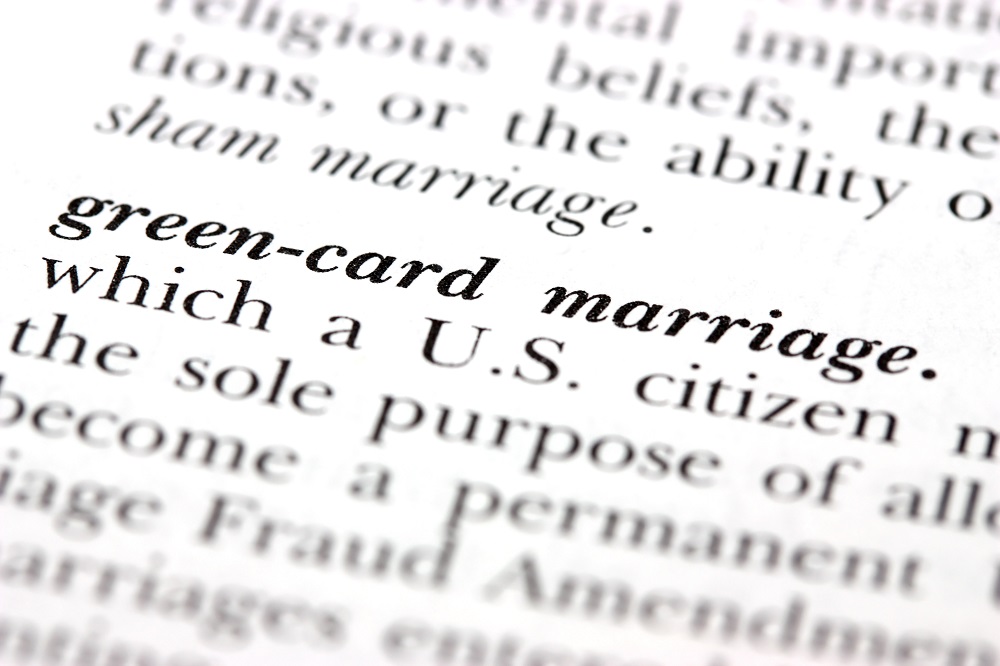
    When you apply for a green card based on your marriage to a U.S. citizen or lawful permanent resident, you can expect to be required to attend an interview. Usually, you and your spouse both have to show up to a marriage green card interview. During this interview, your interviewer will review your application and go over your answers with you – and your interviewer will also try to determine whether your marriage is legitimate. That’s because many people try to commit immigration fraud by getting married. It’s your interviewer’s job to make sure you’re in a bona fide (genuine) marriage, and that you didn’t simply get married so that you could get a green card.

    During your marriage green card interview, the official interviewing you will most likely ask questions like these:

    • How did you two meet?
    • How long did you date before you got married?
    • Who proposed, and what’s the story of your proposal?
    • What was your wedding like, and who attended it?
    • Did you perform (or did someone else perform) any special rituals at your wedding?
    • What kind of food did you serve at your reception?
    • Did you go on a honeymoon? If you did, where did you go?
    • What is your daily life like at home?
    • How often do you communicate with each other when you’re apart?
    • Who cooks and who cleans around the house?
    • How do your children get to school?
    • What are your kids’ favorite activities? Their favorite foods? Who are their friends?
    • Which side of the bed do you sleep on?
    • Does your spouse take any medications?
    • When is your spouse’s birthday, and what do you do to celebrate?
    • What’s the most important holiday in your household, and how or where do you celebrate it?

    The purpose of these questions is to ensure that you’re in a genuine marriage. Your interviewer will be looking for signs that you and your spouse aren’t married because you’re in love, or that you don’t live together and are only married on paper.

    To be very clear, it’s okay if you trip up. Even couples who have been married a long time may have difficulty remembering which medications a spouse takes, who their kids hang out with, or remembering small details. Your investigator is looking at the big picture.

    What’s not okay is being dishonest. If you don’t know the answer to a question, just say so; don’t try to make something up. Making up answers is bad news for your case, because it makes you less credible – and you need the investigator to understand that you’re in a bona fide marriage. If the investigator suspects you’re being dishonest, they may call you back in for a Stokes interview.

    What is a Stokes Interview?

    A Stokes interview is another chance for a couple to prove that they are engaged in a legitimate marriage period during this type of interview, and immigration official will interview you and your spouse together and separately.

    First, the immigration officer will most likely explain to both of you why another interview is necessary. After doing so, the official will most likely separate you from your spouse and ask you questions individually. These questions may be very personal, but rest assured that your spouse is getting the same questions you are. you can expect questions similar to those in your first interview, such as how you met and who proposed. The official may also ask you questions such as:

    • Who typically does the dishes?
    • Do you pay your bills online, or do you write checks?
    • Who gets up first in the morning?
    • How many sinks and toilets are there in your home?
    • Where did you buy your furniture?
    • Who is your phone service provider?
    • What television shows do you watch together or separately?
    • How often do you go out to eat?
    • Where do you keep your toothbrushes?
    • Who fell asleep first last night?

    The immigration official will then compare your answers to see if they match.  

    After both interviews are complete, the immigration official will bring you and your spouse back to the same room together. At that time, they’ll ask you and your spouse to explain any discrepancies in your answers. This type of interview is your last opportunity to convince the immigration official that your marriage is real, and that you didn’t just get married to obtain an immigration benefit. After your interview, the immigration official may approve your petition or deny it. If your petition is denied, you may wish to talk to an immigration attorney about your options.

    Immigration Interviews for U.S. Citizenship

    When you apply for citizenship, you can expect to attend an interview. During this interview, an immigration official will go over your application and verify your answers. They may also ask you additional questions.

    You’ll take your U.S. citizenship test during your naturalization interview. Usually, immigration officials make a decision following this interview. If USCIS needs more information, you won’t receive a decision immediately; you can expect a request for more information to follow.

    Related: Everything you need to know about the U.S. citizenship test

    Do You Need to Talk to an Immigration Attorney About Your Immigration interview?

    If you need to talk to an immigration attorney about an upcoming immigration interview (or anything else related to immigration), we may be able to help you. Call our office at 914-481-8822 to schedule a consultation with an experienced, knowledgeable immigration attorney who can answer your questions and give you the legal advice you need.